For journalists
Rent Rise Check reads every decision the First-tier Tribunal (Property Chamber) publishes on GOV.UK about rent increases (Section 13 of the Housing Act 1988) and rent repayment orders, and makes them searchable by postcode with a link to each original. The findings below are computed from the database as this page is shown, so they are current to 21 Oct 2026; the data was last updated from GOV.UK on 21 Oct 2026. Each sentence carries its n. Quote any of them with the citation at the bottom.
Key findings
- When tenants in England challenged a rent increase at the tribunal, the tribunal set the rent below the landlord's figure in 75% of cases: 1,426 of 1,891 published decisions since 2018 where the landlord's figure and the decided rent can be compared (as at 21 Oct 2026).
- The typical rise landlords asked for was +20.8%; the typical rise the tribunal decided was +10.5% (medians per decision, n=1,843).
- Under the Renters' Rights Act rules (notices served on or after 1 May 2026), the tribunal set the rent below the landlord's figure in 64% of the 85 comparable decisions published so far, all decided July to September 2026. Old-rules decisions decided in the same months, with the same filters: 77% of 189. Typical rise proposed +10.5% under the new rules against +16.7%, decided +5.3% against +7.7% (n=85 and 188). Small numbers so far: decisions are published weeks or months after they are made, and the first new-rules cases may not be typical of those to come.
- A rent increase challenge took a median of 91 days from the tenant's application to the decision (n=2,415 decisions stating both dates); London is the slowest tribunal region at 139 days (n=808) and Southern the quickest at 69 days (n=669). For decisions made in the last six months the median was 82 days (n=642), against 128 days a year earlier (n=205).
- 79% of rent repayment order applications with a known outcome ended in an order (1,212 of 1,539 published decisions since 2015).
- Since the Upper Tribunal set out how the amount is fixed (Acheampong v Roman, 5 September 2022), the typical rent repayment ordered was £3,158 per applicant (median, n=579) and £6,110 per decision (n=585), typically 65% of the maximum the tribunal could have ordered (n=334).
- Letting a shared house without the licence it needed is the commonest ground: 1,079 of the 1,629 published rent repayment order decisions, 83% of which ended in an order (862 of 1,044 with a known outcome).
- Applications for eviction or harassment succeed less often than for an unlicensed HMO (83%): illegal eviction: 52% ended in an order (33 of 64 with a known outcome, all years), 37% since 5 September 2022 (15 of 41); harassment: 25% ended in an order (15 of 59 with a known outcome, all years), 9% since 5 September 2022 (3 of 35). The tribunal has to be sure beyond reasonable doubt that the offence happened.
- A rent repayment order application took a median of 237 days from application to decision (n=1,113).
- No published rent repayment order decision yet concerns an offence on or after 1 May 2026, when the maximum rose from 12 to 24 months' rent.
Download the key findings (text)
What is left out of the percentages: housing association and affordable rents, rooms in shared houses, rents including bills, register-only entries and figures not yet checked by hand. These are only the increases tenants challenged, so they are not typical of all rent increases, and past decisions are not a prediction for any one case. The same figures, by local authority, are on the area pages and rent repayment order area pages.
Chart
The rise landlords proposed against the rise the tribunal decided, median by tribunal region, with n on every row. Free to publish with the credit on the chart.
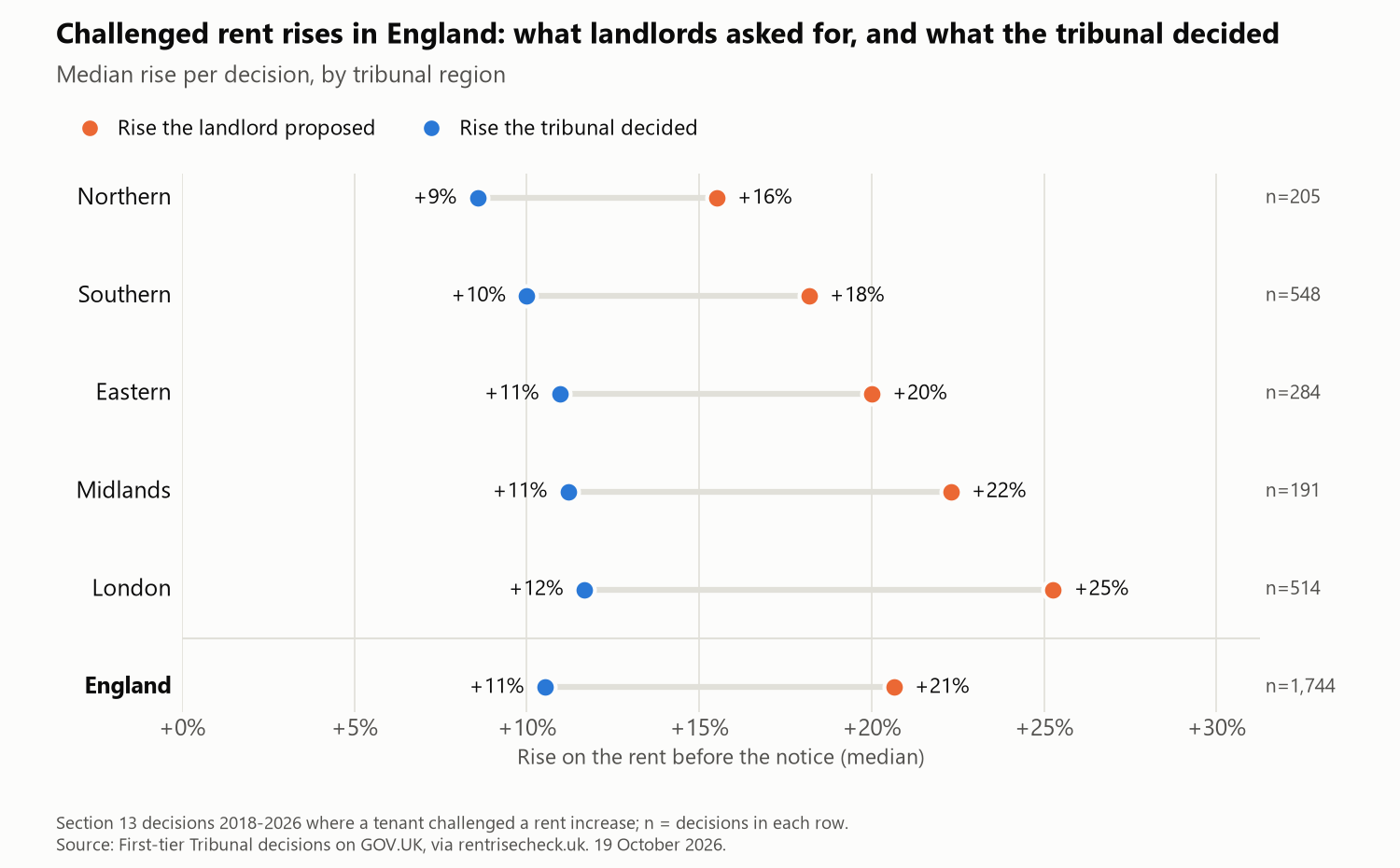
Made on 19 Oct 2026 from the decisions published by then; the figures above are live and may differ slightly.
Data
- Every rent decision as CSV: one row per GOV.UK page, all case types, with the rents, dates, property type and local authority; no decision text and no names.
- Every rent repayment order decision as CSV: outcome, amount ordered, the maximum where stated, offence and dates; landlords' names only where they are companies.
- Both files are rebuilt nightly. The columns are described on the about page.
Method
Each decision is a PDF on GOV.UK. Software reads the rents and dates from the text, a second independent reading cross-checks them, and a figure counts in the statistics only where the two agree and the value appears in the decision's own words. Samples of every kind of figure were then checked by a person reading the decisions, and published only once they met the bar (at least 90% right, nothing confidently wrong). Every correction is on file with its reason. The samples, their results, the errors found and the nightly checks are on How accurate is this?; how the data is made is on the about page. Names are removed from everything shown: tenants, individual landlords, licence holders.
How to cite
"Rent Rise Check analysis of First-tier Tribunal decisions published on GOV.UK", with the date you took the figure and a link to rentrisecheck.uk. The underlying decisions are Crown copyright under the Open Government Licence v3.0.
Contact
Questions, a figure for a specific area or period, or a check of a figure before publication: hello@rentrisecheck.uk. Rent Rise Check is an independent project run by one person in England, not part of the tribunal, HM Courts & Tribunals Service or GOV.UK.